Instructions
Setup
Place Blinks in any arrangement. Any Blink that is connected to two or more tiles becomes a pathway, and any Blink that is connected to only one tile becomes an endpoint. One player plays at each endpoint.

A simple, 2-player Darkball setup
Gameplay
Any endpoint Blink displaying green has a Darkball. Play begins when one player presses their endpoint Blink to release the Darkball. The ball moves along the pathway. At a fork, it chooses randomly. Clustered pathways are treated as forks, and can produce very chaotic behavior.
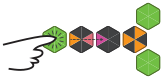
The first Darkball being released in a 3 player game.
When the Darkball reaches your endpoint, you must press the button to bounce it back. If you click too early, your endpoint will go dark for a moment, and you cannot press again until it brightens. If you press too late, you will take damage, as indicated by red lights on your endpoint.
You can then release the Darkball by pressing.
The better your timing, the faster the Darkball will be bounced back. Try to launch the ball with maximum speed to surprise and defeat your opponents.
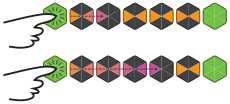
Darkballs being bounced back at slow, medium, and fast speeds.
Win Condition
Once a player has missed the Darkball 6 times, their endpoint will explode, and they are out. The last player remaining is the winner.

The player on the left has taken 6 damage, making the player on the right the winner.
To reset, swap your endpoint Blink for another Blink in the cluster, giving yourself full health.
Solo Variant
Because the Darkball can travel in loops, you can easily create setups with single endpoints. You can use this to test your reflexes or practice your Darkball skills.

An example solo Darkball setup.
Credits
Game Designer
Che-Wei Wang
Artist
Jonathan Bobrow
Darkball is part of the Blinks Game System.